NemoClaw vs. OpenClaw: Putting The Lobster in a Cage?

-
June 10, 2026
-
June 10, 2026
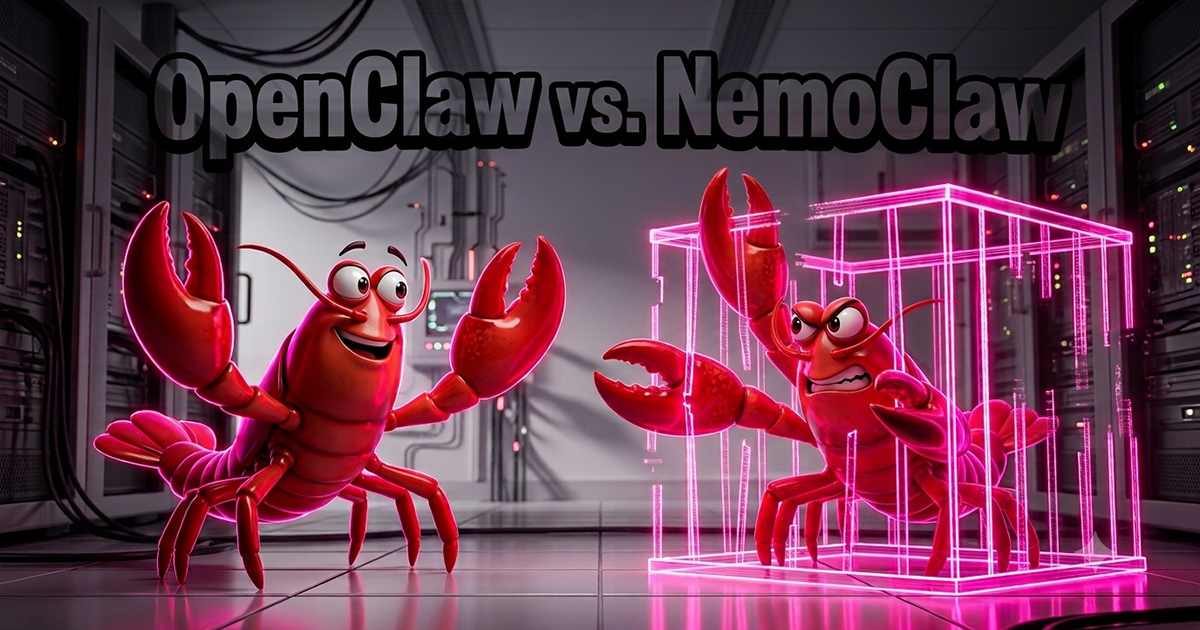
OpenClaw has emerged as one of the most popular open-source AI agent assistants. But giving AI agents direct access to browsers, terminals, files, APIs, and enterprise systems results in significant security risk. NVIDIA's NemoClaw was created to address this challenge; it wraps the framework with security controls designed to make autonomous agents safer.
However, security remains a shared responsibility, and organizations still need strong controls around permissions, integrations, software supply chain security, and human oversight. This article explores what NemoClaw changes, what risks remain, and what organizations should consider before deploying autonomous AI agents at scale.
Key Takeaways
- OpenClaw transforms AI from a chatbot into an autonomous executor, dramatically expanding both its capabilities and attack surface.
- NVIDIA NemoClaw adds some security controls including sandbox isolation, privacy-aware routing, and policy enforcement to help govern agent behavior.
- NemoClaw reduces the blast radius of many attacks, but it does not eliminate core agentic AI risks such as prompt injection, excessive privileges, hallucinations, or malicious third-party integrations.
- Organizations must apply least-privilege access, monitor agent activity, validate integrations, and secure the software supply chain - continuously.
- The future of agent security will rely on layered defenses, combining runtime guardrails like NemoClaw with application security and supply chain risk management throughout the AI lifecycle.
What is OpenClaw?
OpenClaw is an open-source AI agent that acts as a personal assistant. It runs locally on the user's machine and autonomously interacts with real environments: terminals, browsers, files, APIs, and enterprise tools. Unlike traditional AI chatbots that generate text for a human to act on, OpenClaw is the executor: it perceives its environment, plans tasks, takes actions, and self-corrects in a continuous loop with minimal human intervention. This makes it powerful for workflow automation and execution, but fundamentally changes the security model since the AI itself is performing real operations on real systems.
OpenClaw Security Risks
OpenClaw frequently runs with excessive system-level permissions, creating a large blast radius if compromised. It's vulnerable to prompt injection since it ingests content from emails, websites, and documents that can contain hidden malicious instructions. Plus, its community plugin ecosystem (ClawHub) has been found to host over 800 malicious skills including credential stealers and malware.
In addition, many deployments expose dashboards to the internet with weak or no authentication and its internal system prompts can be extracted, leaking the agent's logic and constraints to attackers.
Finally, because OpenClaw can interact with files, browsers, and APIs, it can be manipulated into becoming a malware delivery or data exfiltration tool without the underlying machine ever being directly breached.
What is NemoClaw?
NVIDIA NemoClaw is an open-source stack by NVIDIA designed for running OpenClaw agents more securely and with better governance. NemoClaw runs as a secure wrapper around OpenClaw, so agents can automate coding, file operations, and workflows without unrestricted system access. In addition, NemoClaw integrates with the NVIDIA tooling ecosystem, like NeMo, OpenShell, and NIM inference services.
The solution combines three major components into a single stack:
- Open-source models, like NVIDIA Nemotron, for reasoning.
- The OpenShell execution runtime, for policy-based privacy and security guardrails.
- The NVIDIA Agent Toolkit, a hardened deployment and security layer from NVIDIA, for building, testing, and optimizing agents
NemoClaw Security Controls
NVIDIA's NemoClaw uses four primary protection layers, all configured as deny-by-default and designed to work together.
1. Network Protection
Prevents unauthorized outbound connections and data exfiltration.
Key controls include:
- Deny-by-default egress (nothing can connect out unless explicitly allowed)
- Binary-scoped access controls (only approved executables can reach specific endpoints)
- HTTP and URL path restrictions
- L4 and L7 traffic analysis based on the protocol
- Real-time operator approval for new destinations
2. Filesystem Protection
Prevents tampering with the operating environment and theft of local secrets.
Key controls include:
- Read-only system directories
- Immutable configuration roots
- Limited writable areas
- Kernel-level filesystem restrictions using Landlock LSM
3. Process Protection
Prevents privilege escalation and container abuse.
Key controls include:
- Linux capability dropping
- Separate gateway and agent users
no-new-privilegesenforcement- Process count limits
- Running agents as a non-root user
- PATH hardening
- Removal of compilers and network utilities from the runtime image
- Image digest pinning for supply-chain integrity
- Preventing other host users from reading credentials
4. Inference Protection
Isolates provider credentials from the agent.
Key controls include:
- All model traffic routed through OpenShell
- Provider trust-tier management
- Experimental feature gating via environment variables
In addition, NemoClaw also provides build-time hardened gateway authentication including mandatory device pairing, loopback interface binding, and strict client-allowlisted auto-pairing.
What NemoClaw Doesn’t Solve
NemoClaw adds important security controls around autonomous AI agents, but it does not eliminate the core risks of agentic systems. Many security problems still depend on operational discipline, infrastructure design, and human oversight.
- Prompt injection - The agent itself can still be manipulated by malicious content.
- Excessive permissions - If organizations grant excessive access to agents, the runtime cannot fully protect against misuse.
- Supply chain risk - Third-party tools like MCPs and skills can be malicious.
- Misconfigurations - Unsafe agent behavior resulting from poor configuration
How To Reduce Risk
NVIDIA NemoClaw is not built for production. While runtime isolation and policy enforcement platforms like NemoClaw help contain agent behavior, but organizations still need security controls across the entire development and deployment lifecycle.
A practical approach includes:
- Running agents with least-privilege permissions
- Using short-lived credentials and scoped API tokens
- Requiring human approval for sensitive actions
- Auditing all agent activity and tool usage
- Verifying third-party skills, MCP servers, and integrations
- Continuously monitoring generated code and infrastructure changes
Supply chain security is especially important because agents increasingly rely on external tools and dynamically generated dependencies. This is where agentic endpoint security platforms like Backslash Security become important. Backslash secures AI-driven environments by exposing hidden attack paths and risky agent behaviors. It proactively defends against prompt injection, data exfiltration, compromised MCPs, and the abuse of AI privileges.
AI agents should be treated as high-privilege automation systems, not trusted assistants. Security controls must exist both around the agent runtime and inside the software delivery pipeline itself.
Frequently Asked Questions
What is the difference between OpenClaw and NemoClaw?
OpenClaw is an open-source autonomous AI agent framework that can interact with browsers, files, terminals, APIs, and enterprise systems. NemoClaw is NVIDIA's security-focused wrapper around OpenClaw that adds runtime guardrails, policy enforcement, sandboxing, and governance controls to help reduce security risks.
Is NemoClaw a replacement for OpenClaw?
No. NemoClaw is designed to run on top of OpenClaw. It adds security, privacy, and deployment controls while preserving OpenClaw's core agent capabilities.
Does NemoClaw eliminate AI agent security risks?
No. NemoClaw significantly improves security but does not remove all risk. Organizations must still manage permissions, validate integrations, monitor agent activity, secure credentials, and implement software supply chain security practices.
How does NemoClaw protect sensitive data?
NemoClaw uses multiple security layers including filesystem isolation, network controls, process restrictions, and inference routing. These controls help prevent unauthorized data access, credential exposure, and data exfiltration.
Can NemoClaw stop an AI agent from accessing the internet?
Yes. NemoClaw uses deny-by-default network policies, meaning outbound connections are blocked unless explicitly allowed. Administrators can control which destinations agents can access and under what conditions.
Does NemoClaw protect against malicious MCP servers or third-party tools?
Only partially. NemoClaw can restrict how tools interact with the environment, but it cannot determine whether a third-party MCP server, plugin, or skill is trustworthy. Organizations should validate integrations and monitor agent behavior continuously.
Is NemoClaw suitable for production deployments?
NVIDIA positions NemoClaw as a security-enhanced framework for running autonomous agents, but it is not intended for production. This requires additional controls. Organizations should combine NemoClaw with identity management, access controls, monitoring, approval workflows, and supply chain security practices.
Why is software supply chain security important for AI agents?
AI agents increasingly rely on external tools, plugins, MCP servers, APIs, and generated code. A compromised dependency or malicious integration can bypass runtime protections and introduce security risks. Supply chain security helps identify and reduce these risks before they impact production systems.

Backslash Security is the Agentic AI Endpoint Security platform. We enable enterprises to discover, govern, and protect the agentic AI fabric - every AI agent, MCP server, and Skill running on employee endpoints - securing agentic AI at enterprise scale and business velocity.