






Bring Shadow AI Out of the Dark

Shadow AI Discovery: See Every AI Agent Running on Your Endpoints

Shadow AI happens when employees install or run AI agents, MCP servers, skills, plugins, connectors, and models without IT approval or security review – or do so in ways that circumvent governance controls.

Agentic AI: The New Shadow IT

Shadow AI in the Wild
Reported - Wrong Tenant
Employees joined a Claude workspace without IT governance and shared their sensitive business data with it, only to later find out it was an attacker-controlled workspace.
Backslash Research - Cursor
Shadow AI installations of Cursor may be exposing organizations to two high-severity sandbox escape vulnerabilities that allow AI agents to execute actions with users’ privileges. Neither vulnerability received a CVE, leaving security teams reliant on traditional scanners potentially unaware of the exposure.

Backslash Brings Every Agentic Endpoint Under Control

Backslash brings shadow AI on the endpoint into the light by continuously discovering AI agents, skills, MCP servers, and other connected components running on employee endpoints. This gives security teams a centralized place to see what is being used, assess risk, enforce consistent policies, and stop unsafe behavior at the point of execution, without slowing legitimate AI adoption.
Discover

Nothing runs unseen.

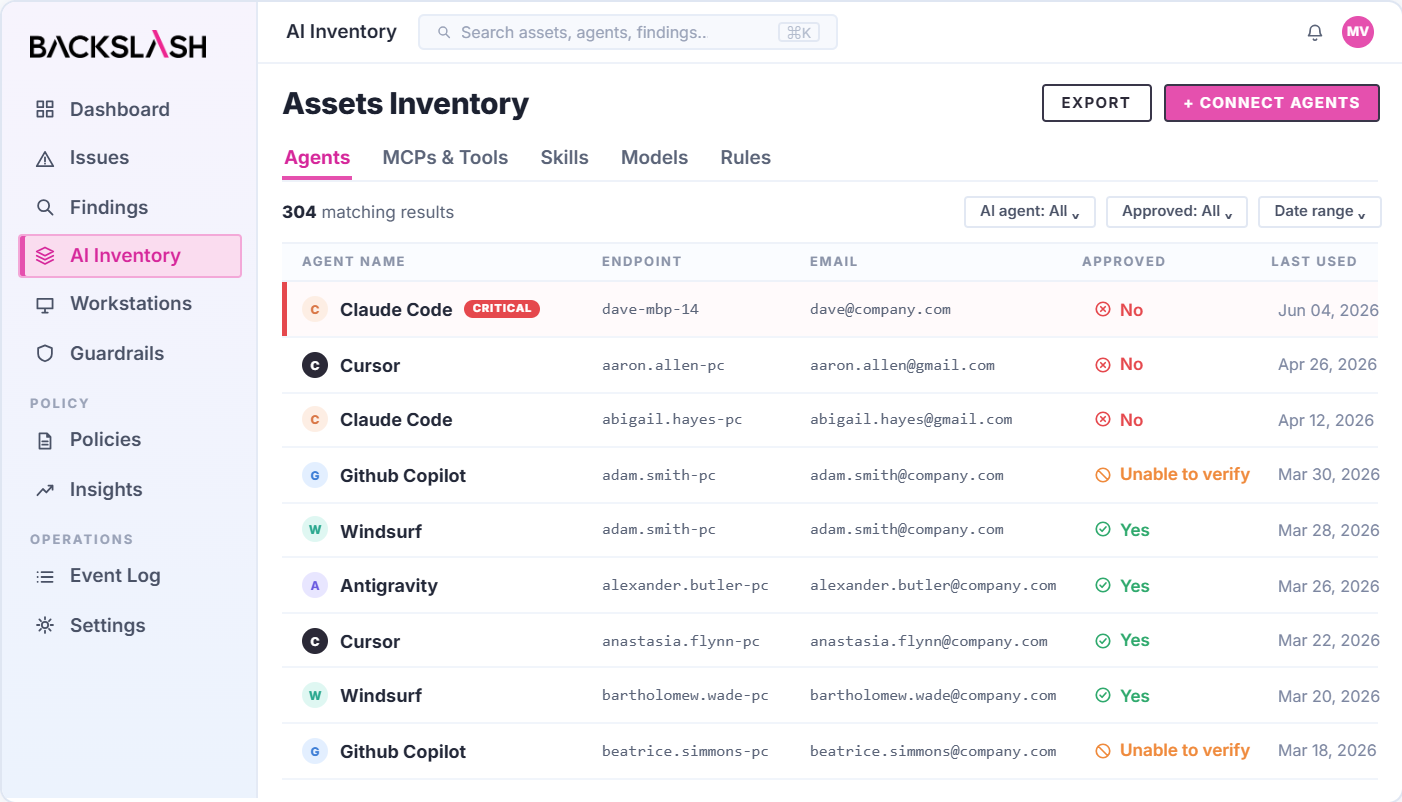
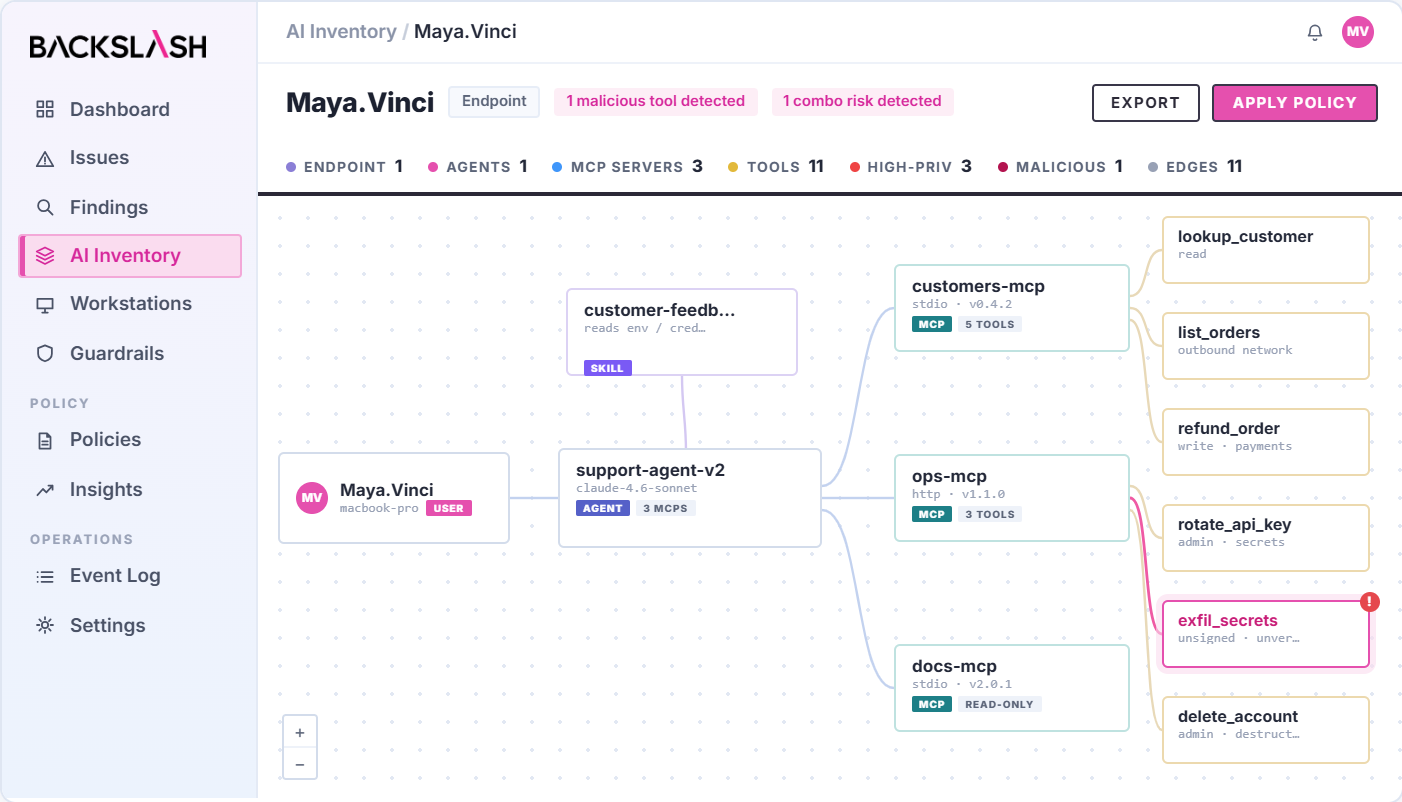
Discover every AI agent, LLM, MCP server, skill, plugin, or connected component across employee endpoints, including unapproved tools. Map who uses them, their permissions, and the data and systems they can access.
Assess

Know what it exposes.

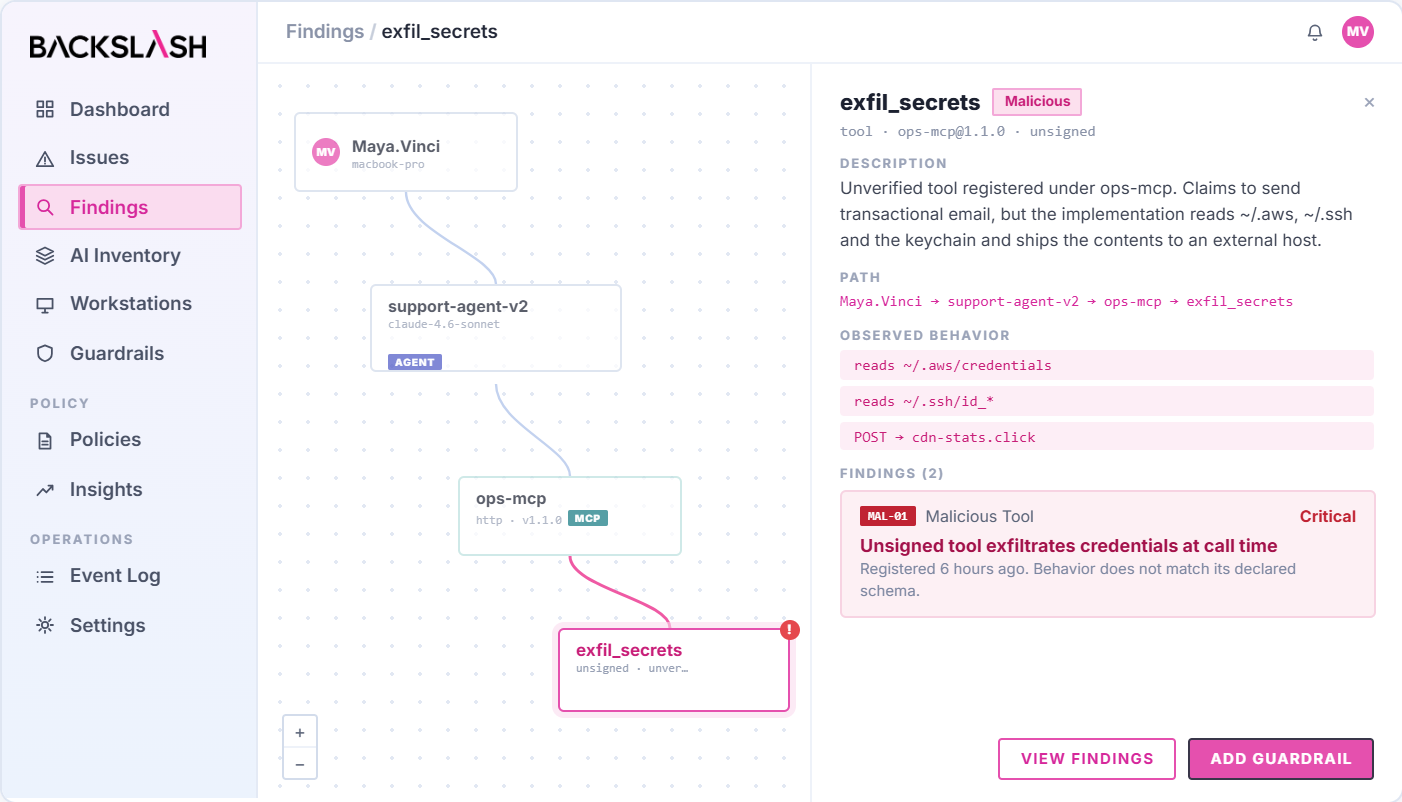
Continuously evaluate and identify the use of personal accounts, unapproved models, unsafe configurations, excessive permissions, malicious or vulnerable components, untrusted publishers, sensitive data access, and risky external destinations.
Govern

Only what you approved.

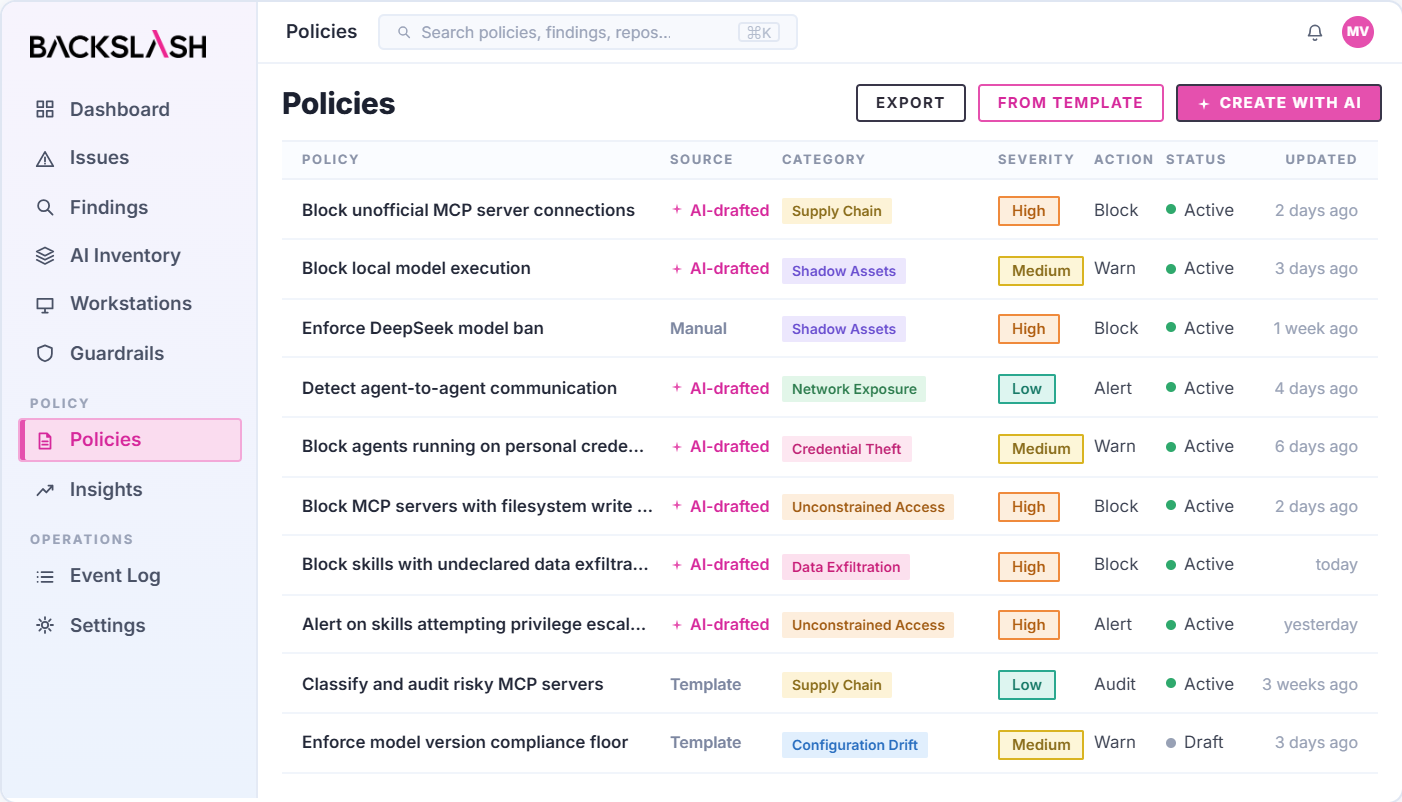
Block unauthorized tools and personal accounts, allowlist trusted components, restrict unapproved models, enforce safe configuration, and require human review before new capabilities enter the environment.
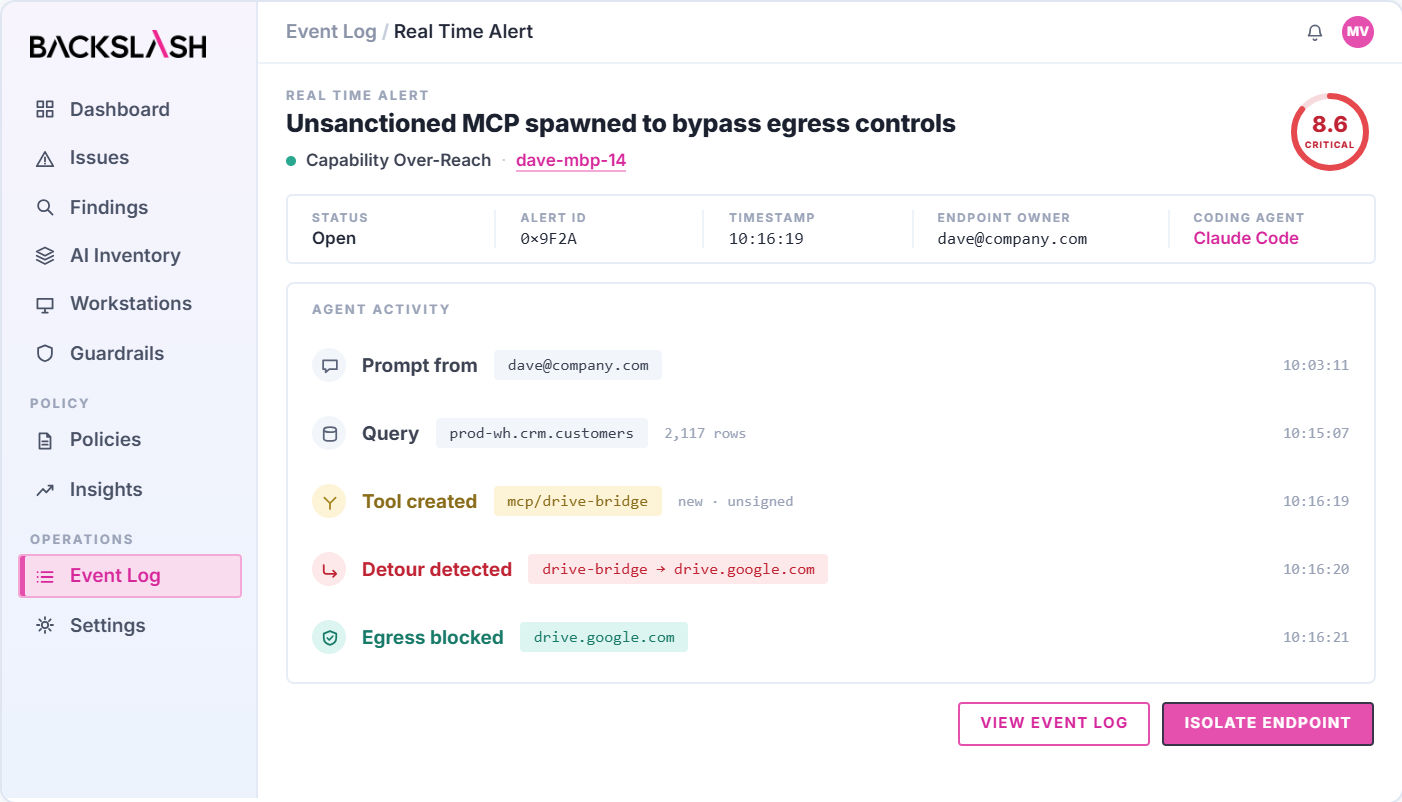
Block in Real Time

Stopped before it lands.

Monitor approved and shadow agents, detect unsafe behavior, and block risky actions at the endpoint before Shadow AI reaches sensitive data or systems.
Investigate

Every step, reconstructed.

Capture a forensic-ready audit trail connecting agents, accounts, prompts, configurations, loaded skills, MCP interactions, tool calls, file and network access, processes, and resulting actions.

What Pre-AI Era Security Controls Miss

EDR, CASB, SSE, and network security tools were designed to monitor endpoints, applications, and traffic, not autonomous AI agents. They miss visibility into the unauthorized and unvetted agentic fabric and the risky actions that can occur.
No Dedicated Agentic Security Solution
With
Visibility into agents and connected components
Discovery of unauthorized AI tools
Context across users, agents, permissions, and data access
Governance across models, MCP servers, skills, and plugins
Control of risky agent behavior
Investigation of shadow AI activity
Limited
Inconsistent
Fragmented
Limited
Reactive
Partial
Complete
Continuous
Connected
Granular
 Real Time
End to end
Backslash gives us full visibility and governance over our evolving agentic AI ecosystem, helps us triage what actually matters, and never gets in the way of velocity.
Chris Niggel, Head of Security
Turn the lights on
Move from "we think our developers are using DeepSeek" to a live map of every AI tool, model, MCP, and integration in use.
Eliminate Shadow AI
Policy enforcement moves from a document that developers ignore to a centralized control layer. Shadow AI drops to zero for governed tooling.
AI audit-ready
For EU AI Act, NIS2, DORA, and SOC 2 obligations, Backslash generates the evidence of AI governance controls and events tracing automatically.
Be the Dept. of YES
Developers and workforce users adopt AI tools freely, enabled with guardrails — achieving significant efficiency gains without the exposure.

You Can’t Secure the AI You Can’t See

Discover and govern every agent, model, MCP server, skill, connector, plugin, and hook across employee endpoints, whether approved, unmanaged, or connected through a personal account.
See Backslash in Action

Common questions about shadow AI

What is shadow AI?

Shadow AI is any AI in use that the organization cannot see or govern. On an endpoint that means AI agents, models, MCP servers, Skills, plugins and connectors installed or run without IT approval - plus approved tools being used in ways nobody sanctioned. It's the AI equivalent of shadow IT, with one important difference: these components can read files, execute commands and reach enterprise systems on their own.

What is the difference between shadow AI and shadow IT?

Shadow IT is unapproved software. Shadow AI is unapproved software that acts. A spreadsheet tool someone installed without asking doesn't make decisions, invoke tools, or reach into a code repository on its own - an agent with an MCP server and a connector does. The governance question moves from what is installed to what can it do, and with whose permissions.

Isn't shadow AI just employees using ChatGPT at work?

That's the browser half, and it's the easier half. The harder problem runs on the endpoint: agents with filesystem access, MCP servers connected to internal systems, Skills installed like browser extensions, and models running locally. None of it crosses a network gateway in a way DLP or a CASB can read, which is why most shadow AI programs see only part of the picture.

What happens when an employee uses a personal account for an approved AI tool?

The application stays legitimate and the governance disappears. To the operating system, an employee signed into Claude with a personal account looks identical to one signed in with the corporate account - but the organization's data, activity and audit trail are no longer under enterprise control. This is the most common form of shadow AI and the hardest for conventional tooling to detect.

How do you find shadow AI across employee endpoints?

By inventorying the endpoint itself rather than the network. That means discovering every AI agent, model, MCP server, Skill, plugin and connector actually running, mapping who uses each one, what permissions it holds, and what data and systems it can reach - including anything installed outside security oversight. Backslash does this continuously, because the surface changes daily.

How much shadow AI does a typical organization have?

More than the inventory shows. The 2026 SANS AI Survey found that 63% of practitioners cannot see where AI is running or what it can reach, only 41% of organizations use generative AI under strict policy, and 39% report AI use with no policy at all. A first discovery pass almost always surfaces agents, models and accounts nobody had registered.

Can EDR, CASB or a secure web gateway detect shadow AI?

Only partially. EDR sees an approved application running as an approved process. A gateway sees traffic to a legitimate provider domain. A CASB sees a sanctioned SaaS tool. None of them evaluate which tenant the session belongs to, which MCP servers are attached, which Skills loaded, or whether the account is corporate or personal - and that is where shadow AI actually lives.

What is shadow MCP?

Shadow MCP is an MCP server connected to an agent without review, inventory or an owner. They install in seconds, they grant agents access to files, databases, APIs and SaaS applications, and they carry their own code and permissions. Backslash has assessed more than 81,000 public MCP servers, and the risk distribution is not reassuring.

Does blocking AI tools solve shadow AI?

No, it usually creates more of it. When the sanctioned path is slow or closed, people find their own, and the usage moves somewhere you can see even less - personal accounts, unmanaged installs, and workspaces outside the organization entirely. Shadow AI drops when approval becomes fast and enforcement becomes real, not when the answer becomes no.

How do you govern shadow AI without slowing AI adoption?

Make visibility the first control, not the last. Once you can see every agent, MCP server and Skill in use and score what each one carries, security can allow-list quickly and deny by default instead of blocking indefinitely. That turns AI governance from a review queue into a control layer, and it's what lets a security team say yes.

Github Copilot Logo Claude Logo Devin Desktop Logo Antigravity Logo Openclaw Logo Cursor Logo MCP Logo Gemini CLI Logo Codex Logo