Visualizing Agentic Endpoint Risk with the Backslash AI Fabric Graph

-
October 13, 2026

-
October 13, 2026
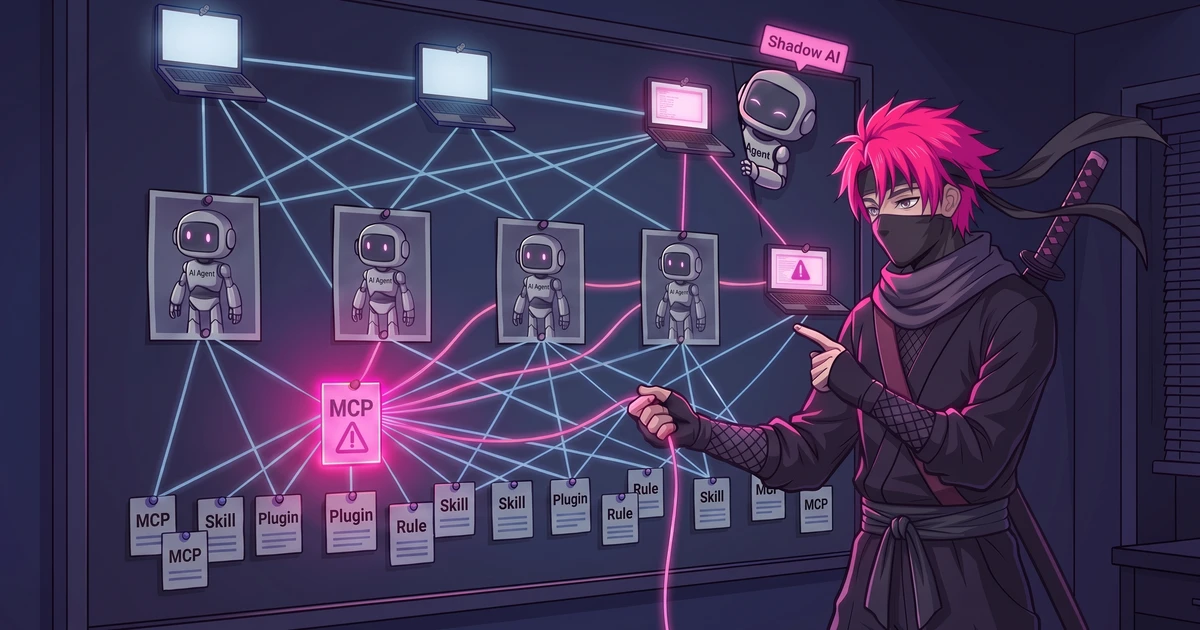
TL;DR:
The AI Fabric Graph connects enterprise endpoints, AI agents, and agentic fabric components in one view. Security teams can see, understand and investigate what their agents and agentic components can access, as well as policy violations, and component sharing. Start with an endpoint or a component, filter for violations, and open the relevant details to investigate.
Do You Understand the Risk Across Your Agentic Fabric?
AI agents introduce an expanding set of components onto enterprise endpoints, including employee-configured MCP connections, skills, and plugins that bundle tools, hooks, and instructions. Each addition can change an agent’s capabilities, access, behavior, and security posture.
The risk introduced by a component depends on how it connects to the rest of the agentic fabric. A malicious instruction in a skill may influence an agent’s use of connected tools. An overly permissive MCP connection may enable access to sensitive data or actions on the endpoint. Security teams therefore need to understand the source of a risk, how it can affect other agents and tools in the chain, and what the resulting impact could be on the endpoint. These relationships help teams assess the scope of exposure and determine where to intervene.
Manually approving which agents employees can use does not establish the risk of their operating environment. Employees can add components, agents can autonomously launch others, and unapproved agents can operate outside the approval process. Assessing risk requires examining the components, permissions, and behavior of each agent in the context of its connections and the endpoint where it operates.
A Connected View of the Agentic Fabric on the Endpoint
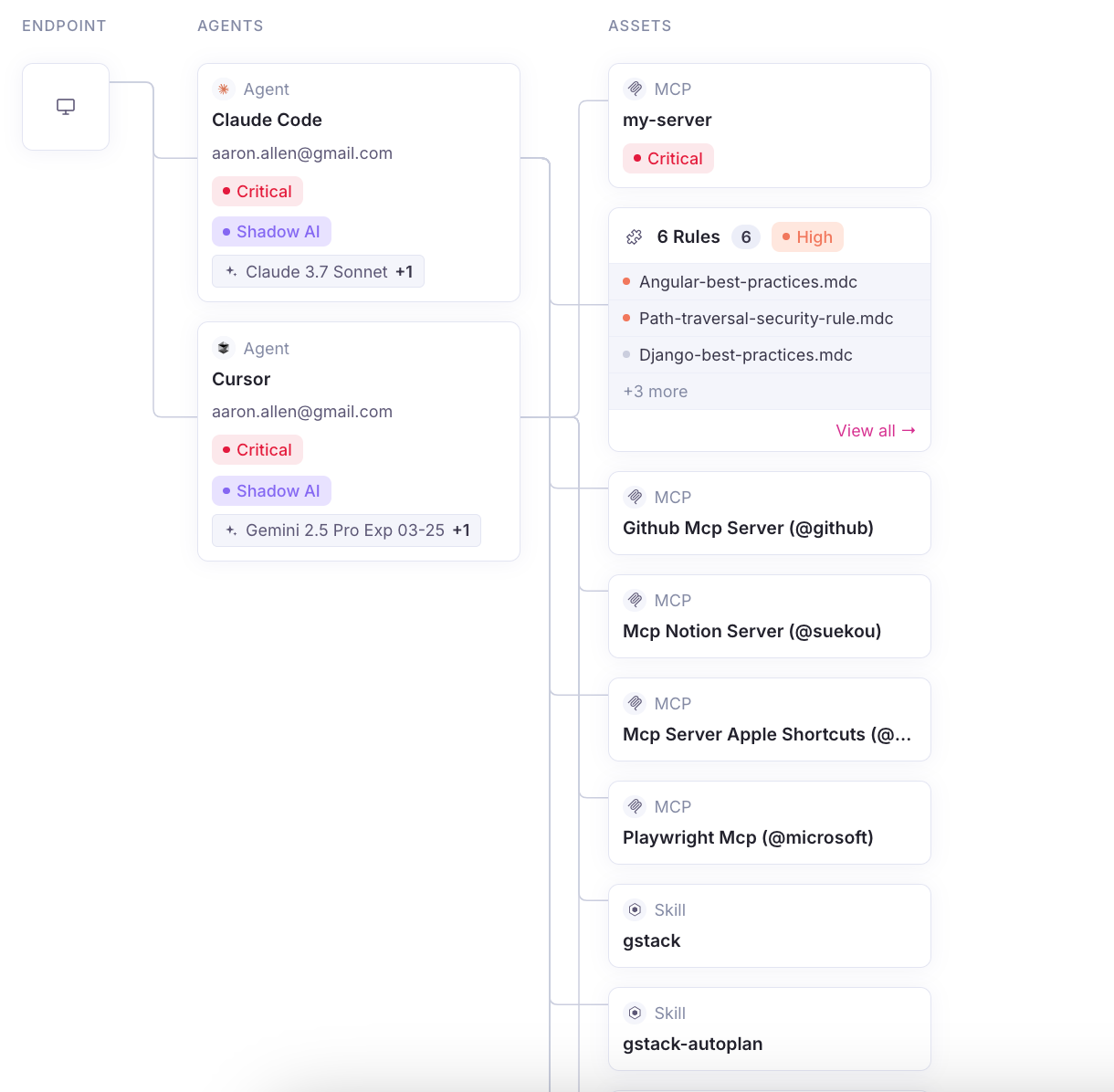
The AI Fabric Graph brings all these components and relationships into one view, drawing the chain from endpoint to coding agent to AI asset. Teams can:
1. See how an endpoint’s agents connect to MCP servers, skills, and rules, with risk severity and Shadow AI indicators in context:
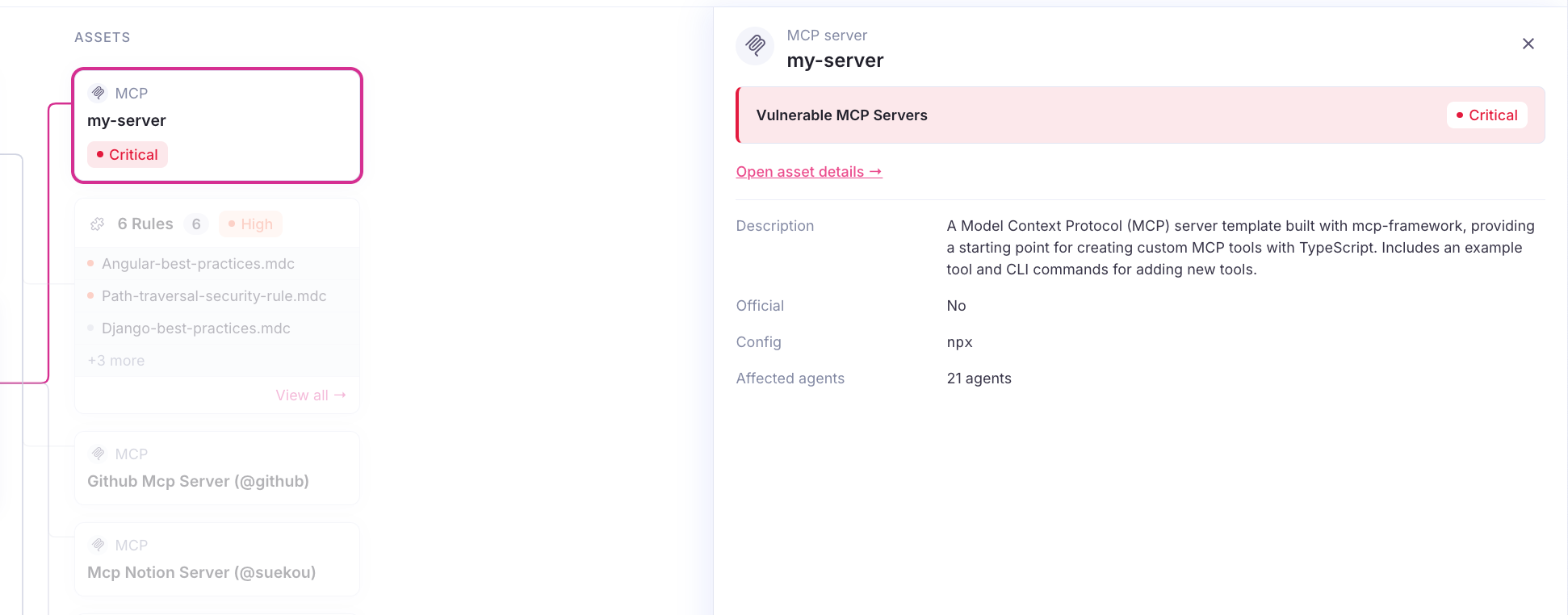
2. Investigate critical findings and see their scope:
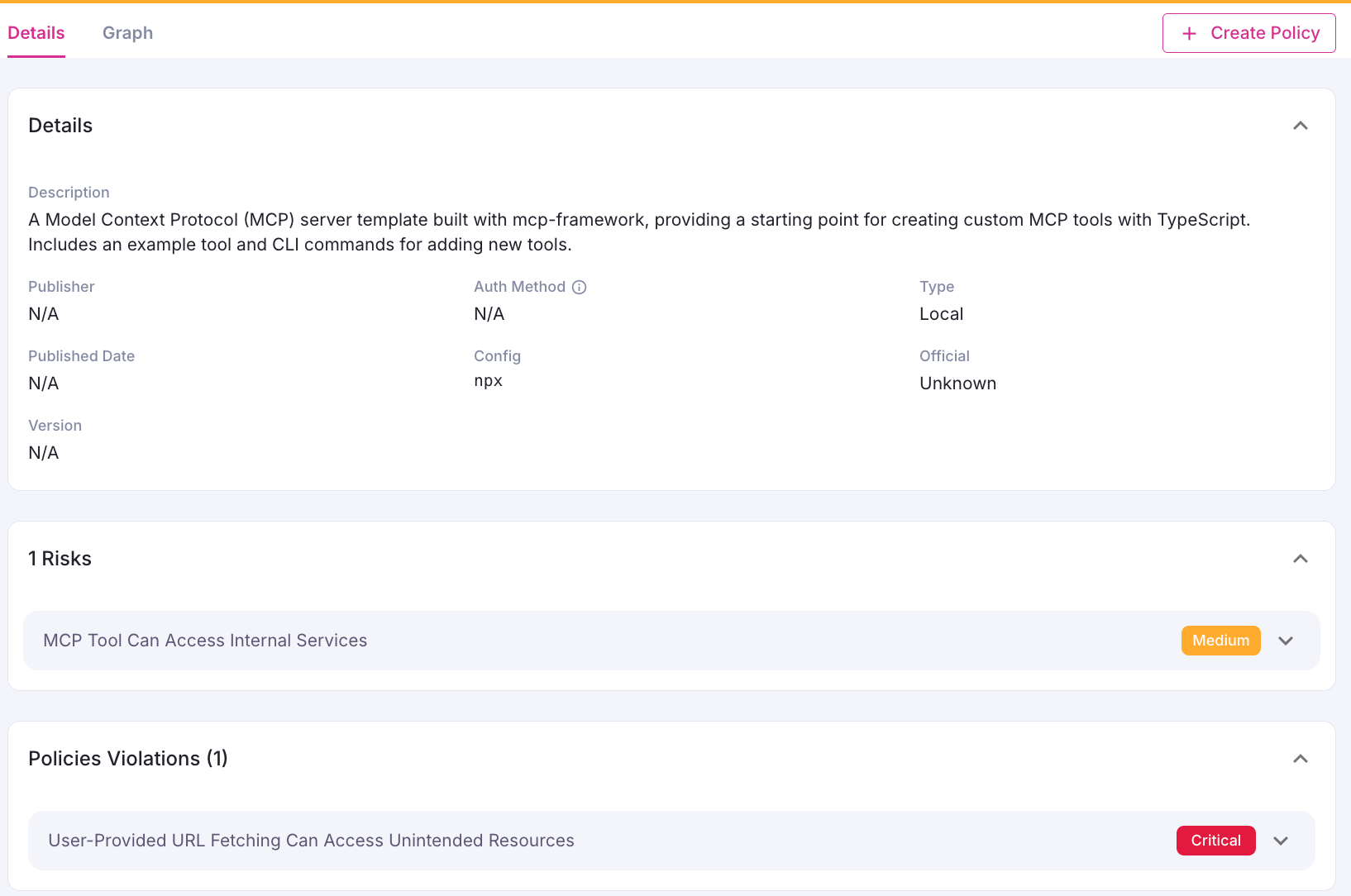
3. Examine the source of exposure through configurations, risk findings, and policy violations, including access to unintended resources:
4. Trace a flagged asset to the agents and endpoints connected to it to understand shared exposure and direct remediation:
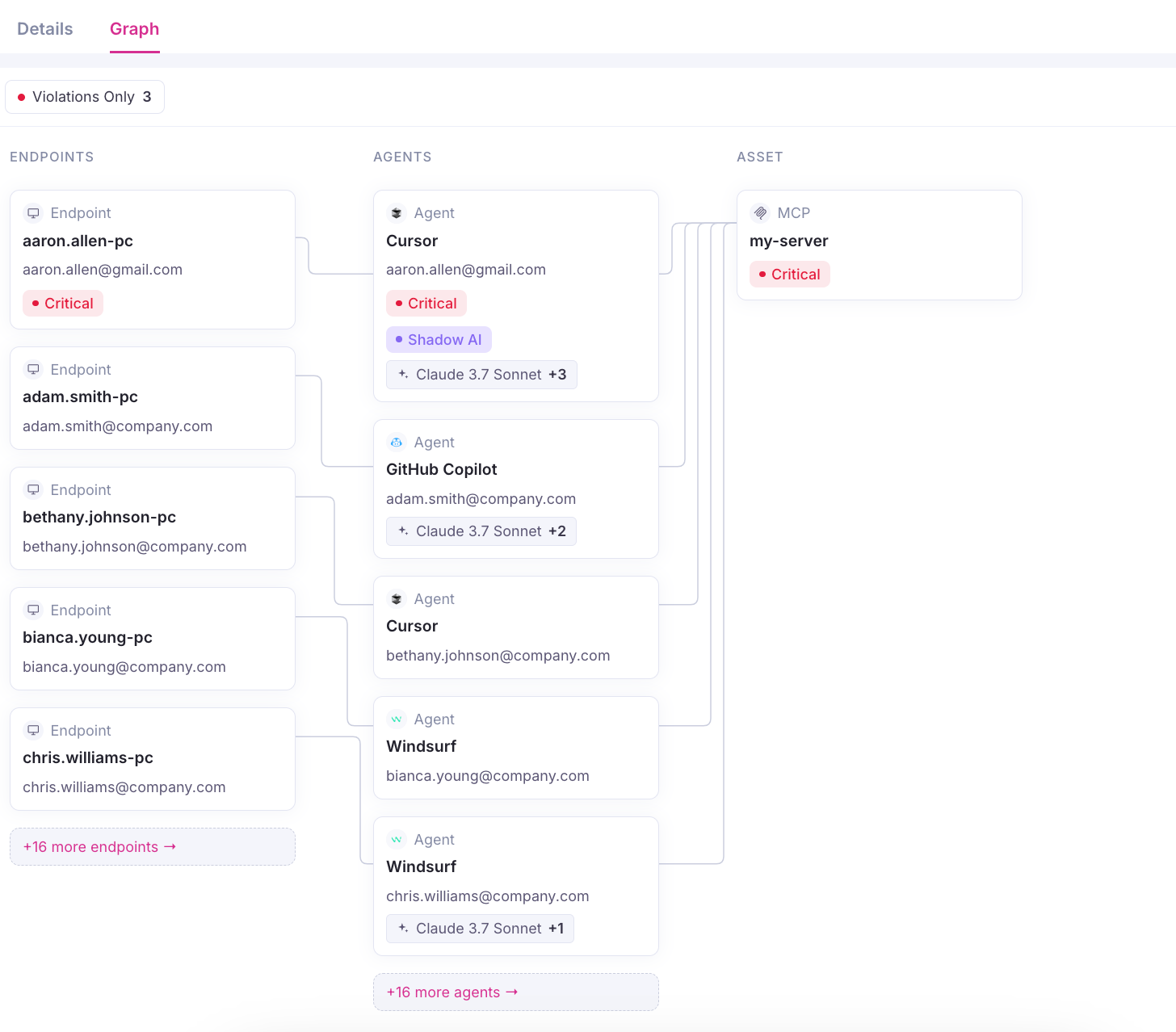
From Agentic Relationships to Better Security Decisions
The AI Fabric Graph supports three practical improvements to security investigations:
- A clearer view of shared exposure. Seeing an asset’s connections helps teams determine which other agents and endpoints may warrant review.
- Faster access to context. Teams can follow the relationships between an endpoint, its agents, and their connected assets in one view.
- More precise investigation. Agent-level violation placement helps teams identify the root cause of the risk, as well as the affected components, so they can tailor remediation actions and policies.
Together, these capabilities help security teams move from finding a concerning asset to understanding where it fits in the environment, what to investigate next and how to remediate.
Visibility and Governance of the Broader Agentic Fabric
The AI Fabric Graph extends enterprise visibility and governance across the agentic fabric. By connecting endpoints, agents, and their components, Backslash gives security teams the visibility and context to investigate findings, identify affected installations, and determine where controls are needed. Backslash helps teams understand and act on their security posture, as employees and agents introduce new components into the environment.
Get your free endpoint exposure assessment.
Common questions
What is Backslash’s AI Fabric Graph?
The AI Fabric Graph visualizes how enterprise endpoints, AI agents, and their associated components are connected, and how a risky component or policy violation affects other assets that inherit the risk. It helps security teams understand these relationships, investigate policy violations, and identify components shared across agents and endpoints.
Why isn’t approving AI agents enough to assess their security posture?
An approved agent can have different configurations and connections on each endpoint, and those can also change dynamically. Employees can add MCP servers, skills, and plugins that change its capabilities and access. Product approval does not establish which components an agent uses or whether those components introduce security risks.
How does the AI Fabric Graph help security teams investigate policy violations?
Teams can start with an endpoint or component, follow its connections, filter for violations, and understand the root source of the violation. Seeing the violations for each associated agent or asset helps teams identify the affected installation and determine what needs remediation.
Can security teams identify components shared across multiple endpoints?
Yes. Starting from a component, teams can see which agents and endpoints connect to it. This helps them understand how broadly a finding extends across the environment.
Maya (Mayo) Pik

Maya is a software engineer at Backslash Security.

Backslash Security is the Agentic AI Endpoint Security platform. We enable enterprises to discover, govern, and protect the agentic AI fabric - every AI agent, MCP server, and Skill running on employee endpoints - securing agentic AI at enterprise scale and business velocity.