






Supply Chain Security for Agentic AI

Stop Agentic Supply Chain Threats Before They Reach Your Endpoints

Backslash secures your agentic fabric from malicious, compromised, and untrusted external components.

Agentic AI: The New Software Supply Chain

Agentic Supply Chain Risks in the Wild
Reported - Shai-Hulud
The Shai-Hulud worm compromised more than 800 npm packages and spread into AI coding tools including Claude Code and VS Code. By manipulating agent hooks and IDE configurations, it executed automatically when developers opened an infected project or started an AI session - stealing credentials and propagating through further packages.
Backslash Research - Codex
Backslash researchers found that outdated OpenAI Codex versions let malicious repositories execute code when developers ran routine commands like /diff. Further flaws affected sandbox controls, credential storage, MCP authentication and security hooks - none of which triggered conventional CVE-based alerts.

Backslash Secures the Endpoint From the Complete Agentic Supply Chain

Backslash continuously discovers and analyzes the components agents load, including the external and nested dependencies behind them. By operating on the endpoint where these components influence agent behavior, Backslash can identify compromised supply chain elements and stop their actions before they reach sensitive data or systems.
Discover

Find every component.

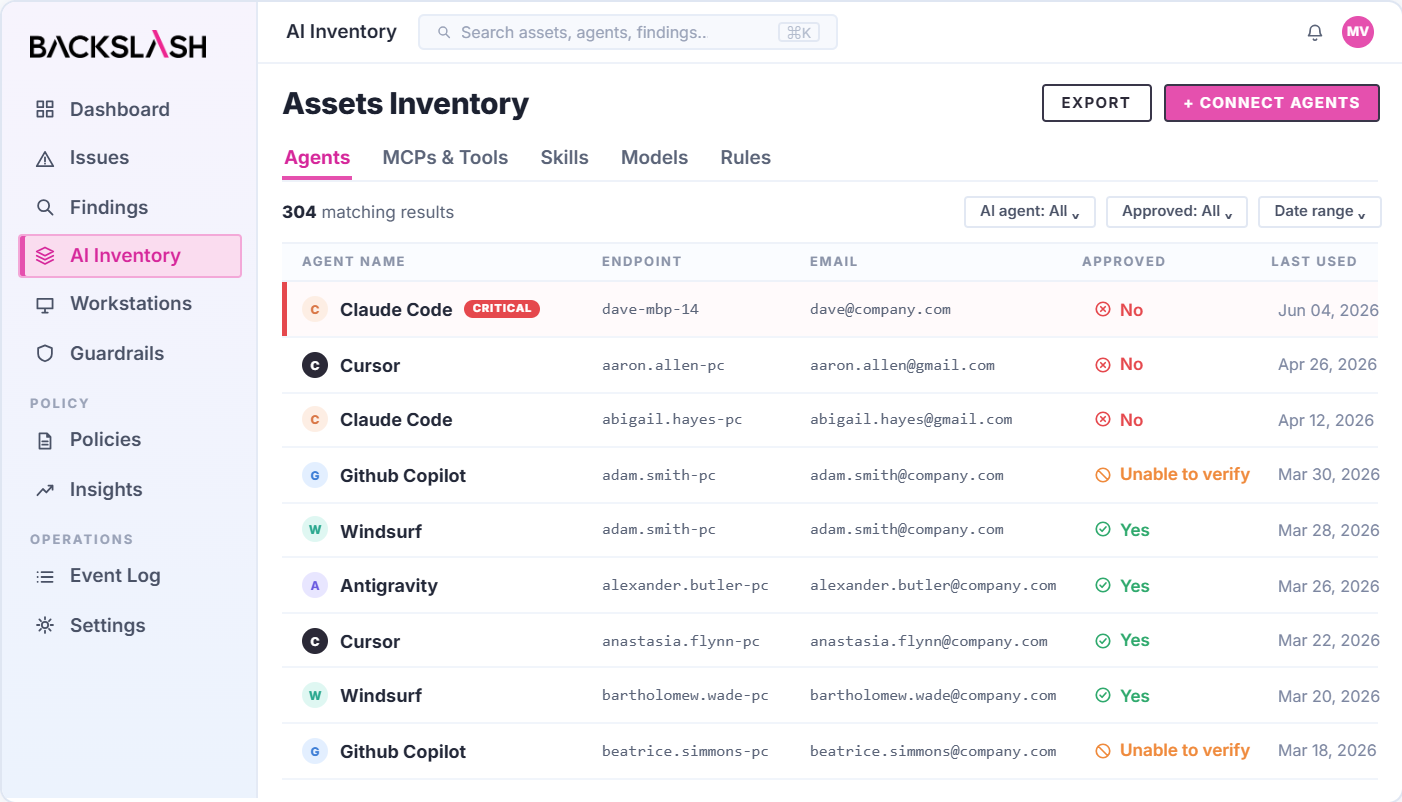
Identify every agentic AI fabric component and map the complete dependency chain. This includes skills that load other skills, bundled scripts, MCP tools, external repositories, remote instructions, and components installed through personal accounts or public package managers.
Assess

Score every dependency.

Continuously evaluate agentic components and their dependencies for malicious instructions, unsafe scripts, suspicious updates, untrusted publishers, excessive permissions, hidden external connections, and other supply chain risks.
Govern

Allow only what's verified.

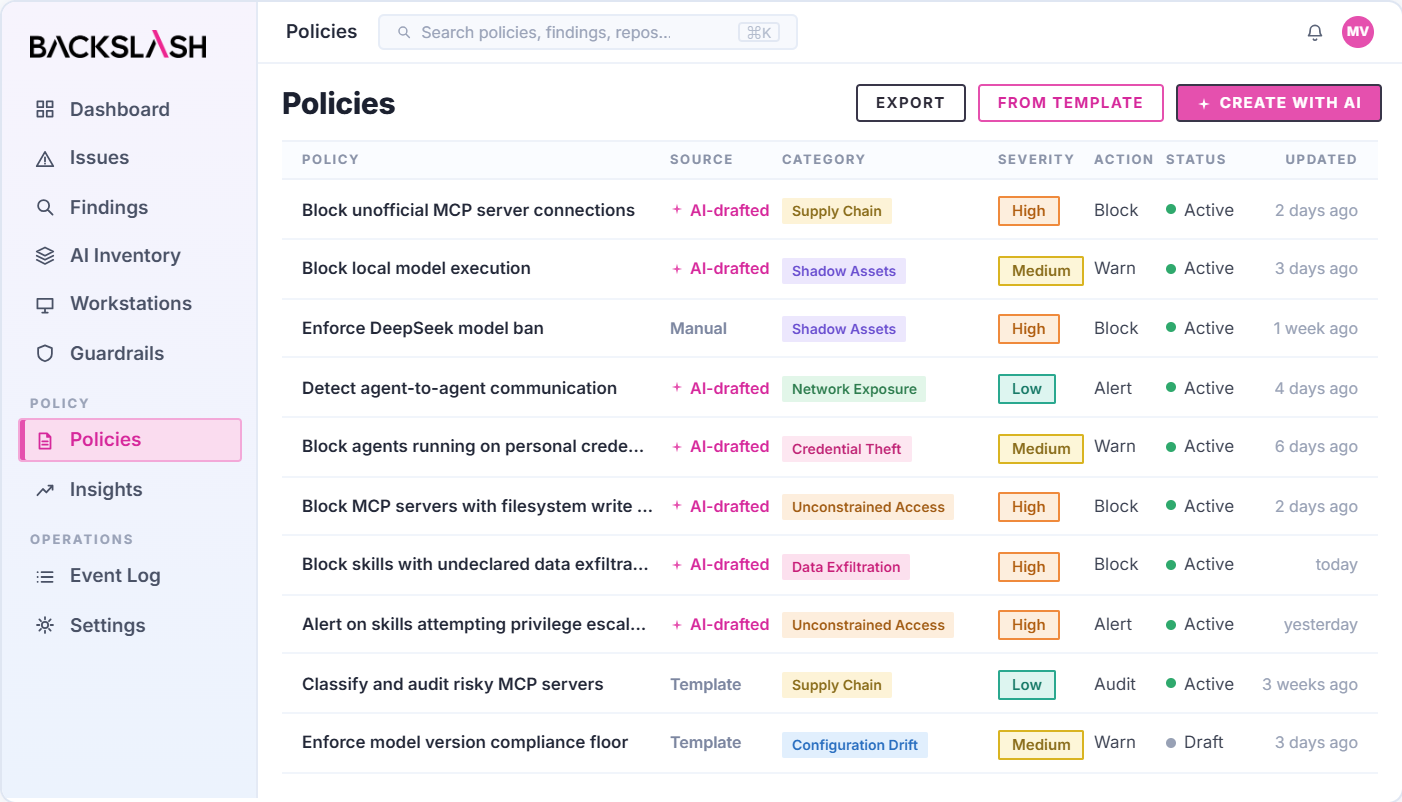
Apply granular policies based on component origin, publisher, version, integrity, requested permissions, available tools, data access, external connections, and observed behavior. Restrict unknown or unverified skills, MCP servers, plugins, scripts, and nested dependencies before they can influence an agent.
Block in Real Time

Block it at execution.

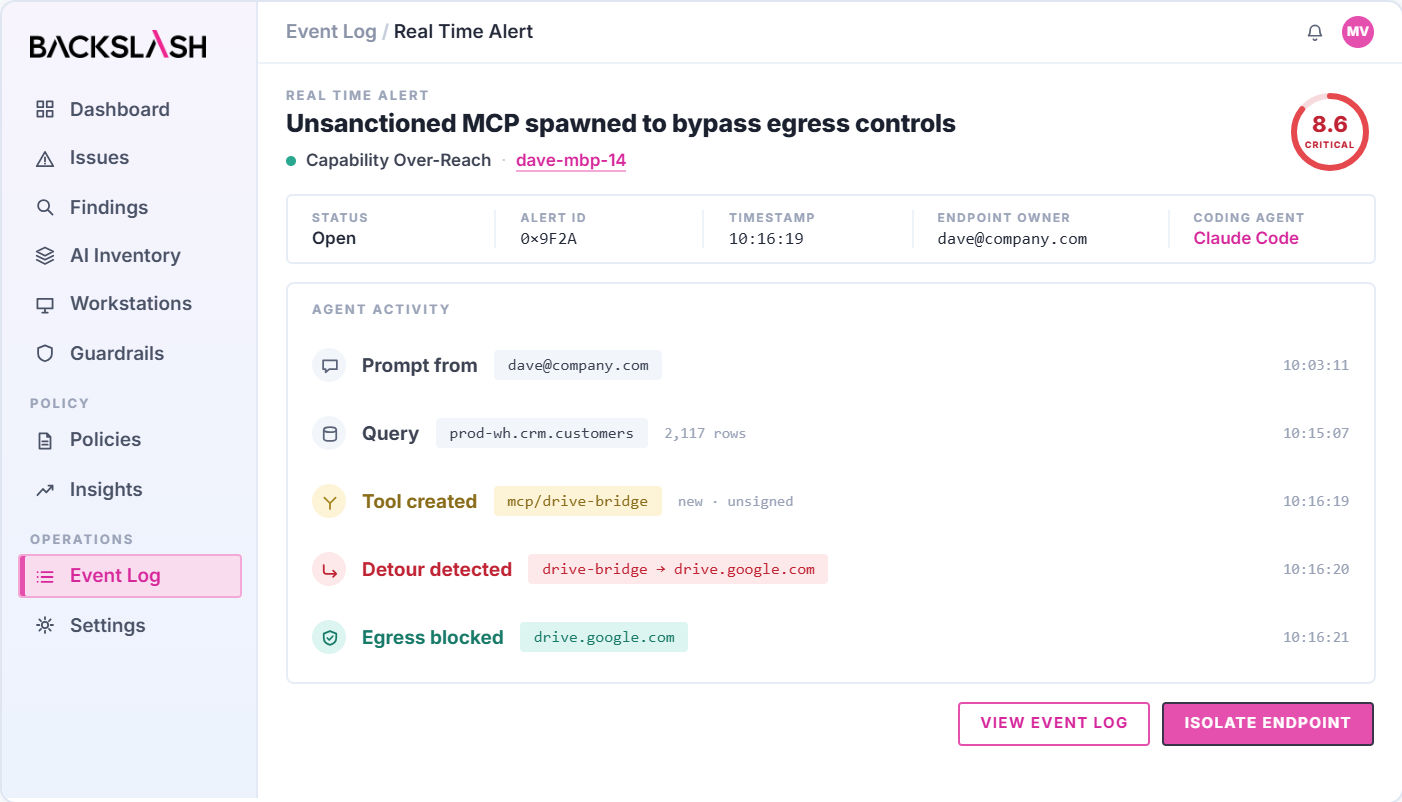
Detect and block when malicious or compromised component risk behavior at the endpoint, even when the threat enters through a trusted agent or an approved top-level skill.
Investigate

Follow the chain back.

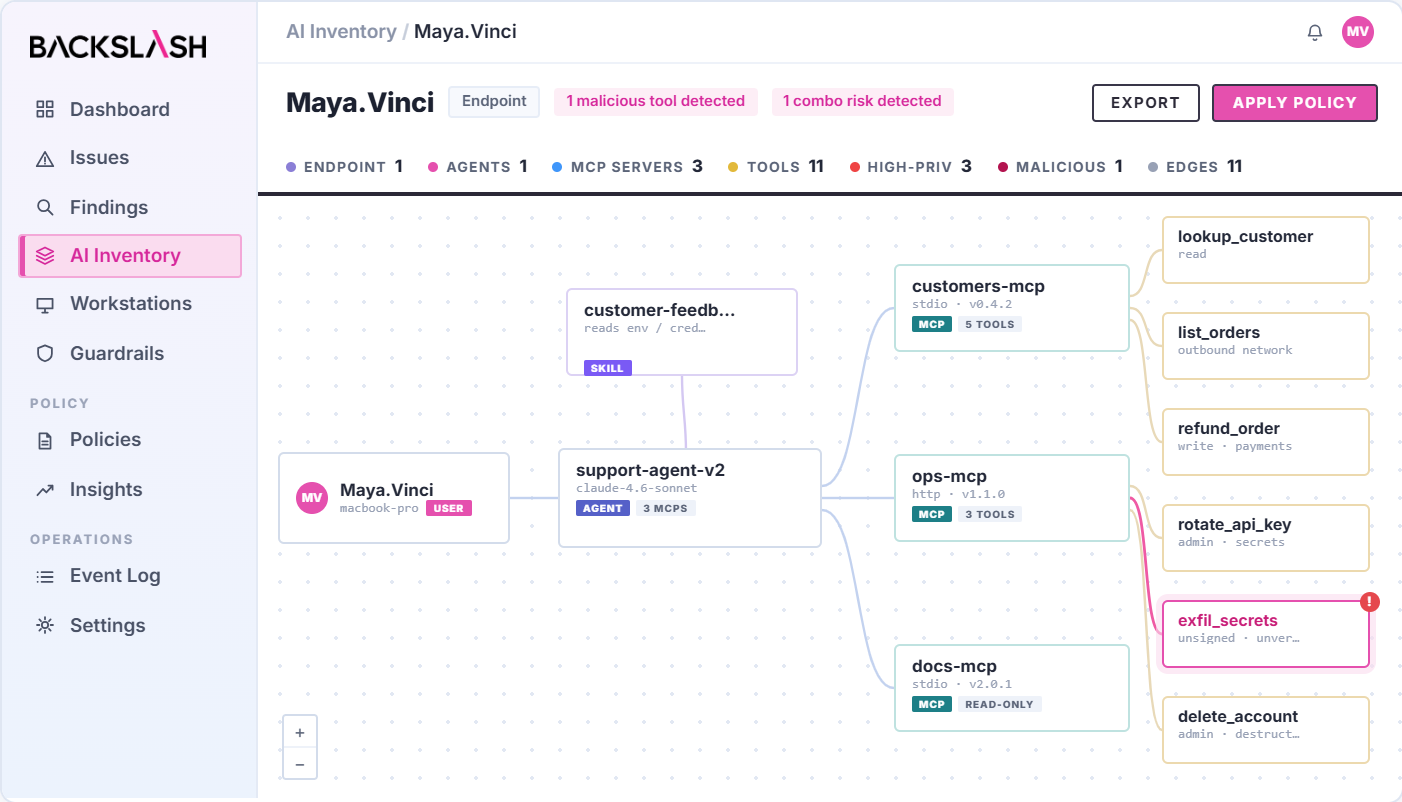
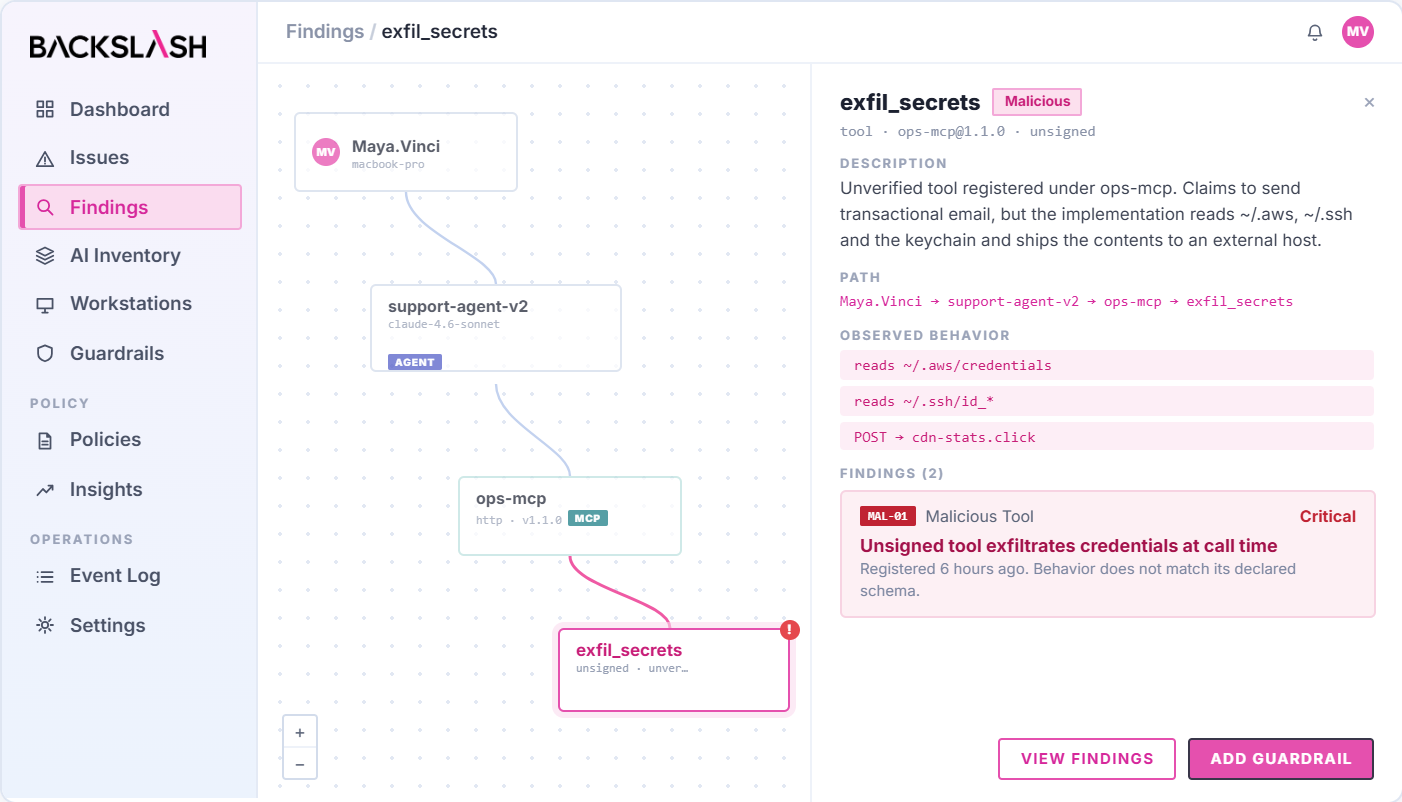
Trace malicious behavior back through the dependency chain to determine which component introduced it, how it reached the endpoint, what it accessed, and which actions it performed.

What Pre-AI Era Security Controls Miss

Software supply chain security tools can identify vulnerable dependencies in the development pipeline, but they miss the runtime context that determines agentic risk: which agents load external or nested components, what permissions those components inherit, which tools and data they can access, and how they behave during execution.
No Dedicated Agentic Security Solution
With
Visibility into agentic components and dependencies
Assessment of external and nested components
Context across publishers, components, tools, and actions
Governance by source, version, permissions, and behavior
Protection from compromised components at execution
Investigation across the dependency chain
Limited
Inconsistent
Fragmented
Limited
Reactive
Partial
Complete
Continuous
Connected
Granular
 Real Time
End to end
Backslash gives us full visibility and governance over our evolving agentic AI ecosystem, helps us triage what actually matters, and never gets in the way of velocity.
Chris Niggel, Head of Security
Turn the lights on
Move from "we think our developers are using DeepSeek" to a live map of every AI tool, model, MCP, and integration in use.
Eliminate Shadow AI
Policy enforcement moves from a document that developers ignore to a centralized control layer. Shadow AI drops to zero for governed tooling.
AI audit-ready
For EU AI Act, NIS2, DORA, and SOC 2 obligations, Backslash generates the evidence of AI governance controls and events tracing automatically.
Be the Dept. of YES
Developers and workforce users adopt AI tools freely, enabled with guardrails — achieving significant efficiency gains without the exposure.

Don’t Let One Compromised Agentic Component Put Your Entire Endpoint at Risk

Protect every agent, skill, MCP server, connector, plugin, script, and nested dependency before a supply chain threat reaches sensitive data or systems.
See Backslash in Action

Common questions about agentic AI supply chain security

What is the agentic AI supply chain?

It's every external component an agent pulls in to do its job: Skills, MCP servers, plugins, connectors, hooks, rules files and the models themselves. Each one is third-party code or third-party instructions running with your agent's privileges on an employee endpoint. The agent is yours; most of what gives it power is not.

How is this different from the traditional software supply chain?

Traditional dependencies pass through a gate. A package enters through a build, gets scanned, and lands in a lockfile someone can review. An agent can be told mid-conversation to install a Skill, connect to a new MCP server, or fetch a script - and it will often comply, especially when the instruction looks like it came from the user or from trusted content it just read. There is no CI, no pull request, and no review step.

Are MCP servers safe to install?

Treat each one as a new member of your software supply chain, not as a browser extension. An MCP server is a running program with its own code and permissions, connecting your agent to files, databases, APIs and SaaS applications. Before installing one you need to know who publishes it, how it updates, whether it carries known vulnerabilities, and what it can reach. Backslash has assessed more than 81,000 public MCP servers, and the risk distribution is not reassuring.

Are AI agent Skills safe?

Some are not. In a study of roughly 98,000 publicly available Skills, researchers confirmed 157 as malicious - carrying hidden instructions meant to steer the agent, or executable code doing more than the Skill advertised. The problem is that a malicious Skill does not look like an attack. It looks like a convenience, and it does its advertised job while doing something else as well.

How do you vet an MCP server or Skill before installing it?

Answer four questions: who publishes it, how it gets updated, whether it has known vulnerabilities or malicious behavior, and what it can actually reach. If you can't answer all four, treat it as untrusted. Backslash runs free scanners for both - the MCP Server Security Hub and the Skills Security Scanner - and assesses internally developed components using the same analysis.

What is an MCP rug pull?

A rug pull is when a component you already trust turns hostile in an update. You installed it legitimately from a real project, so the update arrives without a second look. This is the hardest supply chain path to catch, because nothing unusual happens - no intrusion, no alert, just a normal update to something already approved.

Does npm provenance mean a package is safe?

No, and this is where the Shai-Hulud campaign caught people out. By abusing npm's Trusted Publishing through OIDC, malicious packages shipped with valid provenance. Provenance proves a trusted workflow built the package. It says nothing about whether the source entering that workflow was authorized.

Does SCA or dependency scanning cover Skills and MCP servers?

No. SCA reads manifests and lockfiles for application dependencies. It does not parse Skill files, assess MCP servers and their exposed tools, or inspect agent configuration and rules files - and those are executable artifacts that run before any application code exists. This is a coverage gap rather than a tuning problem.

Can a malicious Skill or MCP server steal credentials?

Yes, using entirely legitimate mechanisms. A component running with the agent's privileges can read credential files, environment variables and configuration, then move data out through a sanctioned tool call. The Shai-Hulud campaign's collector specifically enumerated agent configuration directories including ~/.claude/, ~/.codex/ and ~/.cursor/ - AI tooling is now both the execution platform and the target.

How do you detect a compromised component after it's installed?

Continuous assessment rather than a one-time check, because the component that passed review last month may have updated since. Backslash continuously evaluates every Skill, MCP server, plugin and hook for hidden instructions, malicious behavior, excessive permissions and untrusted dependencies - and assesses combinations, because a credential-reading Skill plus an internet-reaching connector is an exfiltration path that neither component creates alone.

Github Copilot Logo Claude Logo Devin Desktop Logo Antigravity Logo Openclaw Logo Cursor Logo MCP Logo Gemini CLI Logo Codex Logo