Top 7 Agentic Endpoint Security Companies CISOs Should Evaluate in 2026

-
October 1, 2026
-
October 1, 2026

TL;DR
- AI agents now run on employee laptops. Claude Code, Codex, Cursor, and Claude Cowork, etc. read local files, launch processes, use stored credentials, and load MCP servers, skills, plugins, and hooks. That surrounding "agentic fabric" is what makes the endpoint the primary control point.
- The seven vendors below take different paths onto the endpoint. Some are endpoint specialists. Others are broader platforms or existing EDR and network vendors extending onto the device. They differ in what they can see locally, where they enforce and how deep their on-device controls go.
- CISOs should test whether a platform can discover every agent and component on the device, map what each agent can reach, block unsafe local actions before they complete, and preserve endpoint-level evidence for investigation.
Intro
AI security has moved to the endpoint. In 2025, most teams focused on browser-based AI and data loss prevention. In 2026, the focus is coding and desktop agents such as Claude Code, Codex, Cursor, and Claude Cowork, which run directly on employee devices. In Latio's 2026 AI Security Market Report, 45% of surveyed practitioners named endpoint agents as their primary AI security concern, about double any other category. The share of teams with a dedicated AI security budget rose from 8% to 37% in a single year.
The model itself is not the only component that makes endpoint agents risky. The agentic fabric around it is. MCP servers, skills, plugins, hooks, rules, and local models determine which tools an agent can reach, which instructions it follows, and what it can execute.
Traditional endpoint controls weren't designed for this. EDR sees processes, MDM sees installed applications, and network proxies see traffic. None of them connect a prompt, a component, and a permission to the local action that followed. A poisoned skill or an indirect prompt injection can therefore seem like ordinary, authorized user activity.
We compared seven vendors on how they secure agents on the endpoint specifically. We looked at what they discover on the device, which local risks they assess, which on-device actions they can block before completion, how they deploy (endpoint sensor, agentless via MDM/EDR, agent hooks, or gateway), and what endpoint evidence they preserve for investigation.
1. Backslash Security
Backslash Security is an endpoint-first agentic security platform. It was one of the earliest vendors to build AI controls for the endpoint, before the 2026 wave of newcomers. It secures the agents running on developer and workforce devices, including Claude Code, Cursor, Codex, and GitHub Copilot. It also covers the MCP servers, skills, plugins, hooks, rules, and local models that shape how those agents behave. Latio named Backslash a 2026 AI Security Endpoint Leader.
Endpoint approach: Endpoint-native, deployable with or without an endpoint agent.
Top Features:
- Continuously discovers agents, local models, MCP servers, skills, plugins, connectors, hooks, rules, and shadow AI tools across enterprise endpoints.
- Controls endpoint agent settings and what is available to an agent in the first place, including approved MCP servers, skills, commands, and permissions.
- Deploys using an optimized approach of combining agentless discovery and assessment with an endpoint sensor for inline enforcement, so teams can start with visibility and mature into full protection.
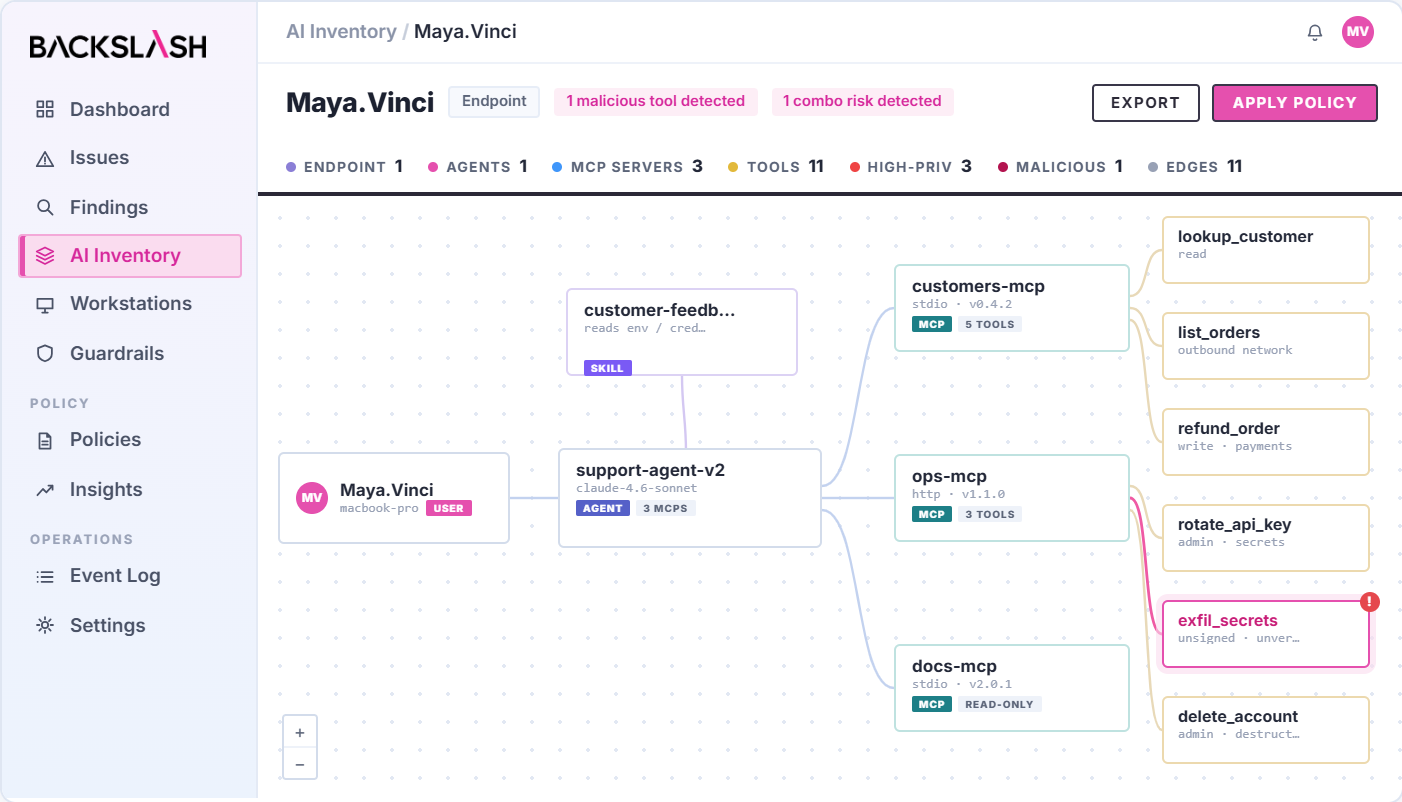
- Maps relationships among agents, components, files, processes, networks, and external services to reveal risky configurations and attack paths.
- Detects prompt injection, malicious or poisoned components, excessive permissions, network exposure, configuration drift, and other agentic threats.
- Blocks unsafe agent actions inline, at the point of execution.
- Maintains detailed records of tool calls, subprocesses, file access, network activity, and resulting actions for investigation and response.
- Assesses agentic environments against established frameworks, including OWASP guidance and MITRE ATT&CK.
Enterprise Strengths:
- Control depth on the endpoint. Backslash goes beyond flagging malicious components to govern agent configuration and which tools and permissions an agent can use.
- Visibility, blocking, and investigation all sit in one endpoint-focused platform.
- Adds the agent-level context that EDR and MDM lack, and complements rather than replaces them.
- Publishes original vulnerability research on agent components, which feeds its component risk scoring.
Questions to Validate:
- Which actions can be blocked before completion?
- How are sensitive prompts and files handled in audit records, and which SaaS or cloud workflows require additional controls?
- Which controls require the endpoint sensor, and which are available in agentless mode?
Best Fit: Security teams that need to discover, govern, and block risky agents and components directly on endpoints. Especially strong where developer coding agents are the top priority, and where there’s widespread adoption of cowork agent automation.
2. Palo Alto Networks: Prisma AIRS Agent Security (Koi)
Overview: Following its 2026 acquisition of Koi, Palo Alto Networks added Koi Agentic Endpoint Security to its AI security portfolio. Koi discovers and assesses AI agents and other software on employee devices and provides endpoint controls. It is available as a standalone product and as an integrated module within Prisma AIRS and Cortex XDR. Prisma AIRS also provides separate capabilities, including AI gateway protection and agent security testing.
Endpoint approach: Originated in network proxy and gateway controls; endpoint coverage added via acquisition.
Top Features:
- Endpoint controls for coding agents, covering local MCP servers, plugins, and skills.
- Scans agent configurations, MCP servers, and skills for security risks.
- Assesses risks in AI agents and other software running on endpoints through Koi.
- Provides endpoint controls through Koi, alongside separate Prisma AIRS capabilities for agent testing and gateway-based inspection.
- Governs agent identities, ownership, and permissions, with audit trails.
Enterprise Strengths:
- Endpoint supply chain coverage (extensions, packages, plugins)
- Pairs predeployment testing with runtime prevention.
- Existing Palo Alto customers can consolidate onto a single vendor.
Questions to Validate:
- Which local components and execution events can endpoint controls observe and block, and which require gateway or platform integrations?
- Which deployment components and integrations are required to achieve the advertised coverage?
- How fully is the acquired endpoint technology integrated into Prisma AIRS, and which capabilities still sit in a separate console or agent?
Best Fit: Palo Alto customers who want to extend existing network and platform controls onto developer endpoints.
3. SentinelOne: Prompt Security
Overview: Following its 2025 acquisition of Prompt Security, SentinelOne expanded its AI security offering within the Singularity platform. Prompt Security provides visibility into employee AI use and discovers MCP activity, including activity associated with local processes and developer tools. Its MCP gateway inspects interactions routed through it and applies policies to those interactions. Buyers should distinguish that gateway enforcement from controls that run directly on an endpoint.
Endpoint approach: AI-use discovery through Prompt Security deployment options, with MCP interaction enforcement through its gateway.
Top Features:
- Discovers coding assistants, local agents, MCP servers, and shadow AI tools on endpoints.
- Allows or blocks MCP interactions by user, server, or action, down to the tool-call level.
- Redacts sensitive data and blocks adversarial prompts and unsafe outputs.
- Enforces policy through a lightweight endpoint agent or an application reverse proxy.
- Provides searchable interaction logs for investigation.
Enterprise Strengths:
- AI agent findings sit in the Singularity console alongside EDR telemetry.
- Granular MCP tool-call controls and risk-based server assessment.
- A single vendor for endpoint agents, browser AI, and first-party apps.
Questions to Validate:
- Which other agentic components - skills, hooks, plugins, and local models can the platform discover and assess?
- Which deployment components and integrations are required to achieve the advertised coverage?
- Is agent security delivered through the existing Singularity sensor, or through a separate endpoint agent?
Best Fit: SentinelOne EDR customers who want to add AI agent and MCP governance to their existing endpoints without introducing a new vendor.
4. Neo Security
Overview: A recently launched endpoint software-control platform that governs AI agents and the software around them at the point of execution. Its focus is controlling what agents and AI-enabled applications are allowed to do on the device, and attributing those actions to identities.
Top Features:
- Inventories AI agents, MCP servers, plugins, extensions, models, and AI-enabled applications across endpoints.
- Maps software capabilities, permissions, configurations, identities, and potential attack paths.
- Enforces on-device runtime policies that can allow, block, or hold an agent action for verified human approval.
- Lets security teams create policies through an LLM interface and deploy them across endpoints.
Enterprise Strengths:
- Prevention at execution, so actions are stopped on the device rather than detected afterward.
- On-device inventory spanning agents, MCPs, skills, plugins, models, and AI-enabled applications.
- Ties local agent actions to human and non-human identities.
- Human-in-the-loop approval for sensitive endpoint operations.
Questions to Validate:
- How are LLM-generated policies reviewed, tested in audit mode, approved, and rolled back?
- Which operating systems and agent applications support each enforcement action?
- How are risk scores calculated, and which security-framework mappings are available?
Best Fit: Organizations that want execution-time software control on endpoints, linking agent actions to identities and requiring approval for sensitive local operations.
5. AIR Security
Overview: A recently launched “context firewall” for agents on the device. It reports discovery and governance of agents, vetting of add-ons such as skills, plugins, and MCP servers, and protection during agent activity. Its public descriptions do not establish that every type of local operation is intercepted, so buyers should verify the enforcement scope in a live demonstration.
Top Features:
- Vets agent add-ons, including skills, plugins, commands, hooks, and sub-agents, MCP servers, and reports runtime protection for agent activity.
- Detects hidden instructions, prompt injection, excessive permissions, and supply chain compromise in local add-ons.
- Provides a marketplace for pre-vetted external and certified internal add-ons.
Enterprise Strengths:
- Emphasis on assessing untrusted add-ons and other context before an agent uses them.
- Covers add-ons before install, after updates, and at runtime.
Endpoint Questions to Validate:
- What endpoint evidence does AIR retain after an incident? Can it reconstruct the full chain from prompt, to component, to subprocess, to file and network activity?
- Which local components can it discover? Specifically, does that include local models, and configuration changes over time?
- Can it be deployed agentlessly, and which controls require the endpoint sensor?
- Which local actions, beyond context inputs, can it block before completion? For example, shell commands, file writes, and outbound connections.
- Is marketplace use optional, and can organizations approve private or unlisted add-ons?
- What references exist for comparable enterprise endpoint deployments?
Best Fit: Teams that want to deeply govern endpoint agents, especially those concerned about agents running with local user privileges and third-party add-ons.
6. Glow
Overview: Glow is a recently launched endpoint inventory and software-control platform. It governs AI tools as one layer of broader endpoint software management.
Endpoint approach: Endpoint software inventory and application control.
Top Features:
- An inventory of endpoints and every software layer on them, including AI tools, extensions, and packages.
- Blocks unapproved AI tools and components at install time.
- Adaptive software policies with agent-based remediation.
Enterprise Strengths:
- Fills the MDM gap around application-layer control and approval workflows for developer tools.
- Covers supply chain risk from packages and extensions alongside AI tools.
- Reduces manual remediation and ticket backlogs.
Questions to Validate:
- What visibility is available into prompts, MCP tool calls, component configurations, and agent execution events beyond software inventory?
- How can remediation policies be tested and actions reversed to avoid disrupting legitimate software?
- Which capabilities extend beyond existing UEM and EDR tools, and how does the platform integrate with them?
Best Fit: Organizations that want to control which AI tools and components get onto endpoints in the first place. Less suited to teams that need deep inspection of agent prompts and tool calls at runtime.
7. Zenity
Overview: Zenity is a cross-platform AI agent security platform with coverage across SaaS, cloud, and coding agents. For supported coding agents, it reports posture assessment and runtime monitoring using OpenTelemetry and native agent hooks, without requiring an endpoint sensor. Its telemetry includes tool calls, MCP interactions, and file access. Buyers should verify which supported hooks can prevent an action before completion and which provide detection or response afterward.
Endpoint approach: Agentless instrumentation of supported coding agents through OpenTelemetry and native hooks, alongside API-based integrations for other AI environments.
Top Features:
- Discovers local coding agents alongside SaaS and cloud agents, including their tools, permissions, and data access.
- Traces tool calls, data usage, and execution paths.
- Blocks prompt injection, exfiltration, and tool misuse.
- Governs agent identities, privileges, static keys, and secrets.
Enterprise Strengths:
- One policy set covering endpoint agents and SaaS and cloud agents.
- Strong incident context around tool calls and data usage.
- Suited to enterprises where local agents connect into sprawling SaaS environments.
Questions to Validate:
- Which endpoint controls run through a local sensor, which through agent hooks, and which depend on API integrations?
- Which actions can Zenity prevent before completion, and which generate detections or trigger a subsequent response?
- What on-device visibility is available into local files, subprocesses, and MCP servers?
Best Fit: Enterprises that want endpoint agents governed under the same policies as the rest of their AI estate.
What CISOs Should Consider
It can be hard to compare agentic security vendors when every platform promises visibility, governance, and runtime protection. Look past the shared language to each vendor’s strongest control point. Decide between an endpoint specialist and a broader platform. If AI security is your priority and you need more control over employee devices, endpoint specialists offer the deepest on-device governance and runtime control.
Backslash and Neo focus on local agent components and actions; Glow emphasizes endpoint software inventory and remediation; AIR Security focuses on the inputs and add-ons agents consume. Palo Alto Networks, SentinelOne, and Zenity span endpoints and other AI environments, but differ in their emphasis on testing, identity, AI usage, and application security.
Ask shortlisted vendors to demonstrate the same scenario on a live endpoint: discover a new component, detect a permission change, block a prohibited action before it completes, and show the evidence left for investigation. Compare the deployment work and effect on legitimate workflows alongside the security results.
Methodology: This comparison draws on the public sources cited in each vendor section. Capabilities are vendor-reported unless explicitly identified as independently verified. Best Fit entries are editorial assessments, and Questions to Validate identify evaluation requirements rather than confirmed deficiencies. An undocumented capability should not be assumed unavailable. Market context, survey figures, and vendor recognitions are drawn from Latio's 2026 AI Security Market Report.
Common questions
What is agentic endpoint security?
Agentic security is the practice of discovering, monitoring, governing, and protecting AI agents and the systems they interact with. This can include agents running on employee endpoints, SaaS platforms, cloud environments, IDEs, and custom AI applications, as well as components such as MCP servers, skills, plugins, connectors, models, and tools. Effective agentic endpoint security focuses not only on identifying agents, but also on understanding what they can access, what actions they perform, and where security policies can be enforced.
What additional context can agentic endpoint security provide beyond existing controls?
EDR, MDM, identity, and DLP tools remain essential, but they see agent activity only as generic processes, installed apps, or traffic. Agentic endpoint security adds the missing link between the prompt, the component, and the permission that produced a local action, and it can enforce policy at that point.
How should enterprises choose between agentic endpoint security vendors?
CISOs should evaluate where the platform provides visibility and where it can actually enforce security controls. Most organizations will have existing partial coverage of agentic risk through DLP, network, and MDM solutions, but a dedicated agentic endpoint solution should cover gaps they cannot cover. Important considerations include agent and component discovery, runtime monitoring, identity and permission visibility, prompt-injection protection, MCP and plugin security, policy enforcement, integration with the existing security stack, forensic capabilities, and support for the organization’s operating systems and AI frameworks. Deployment requirements, performance impact, false positives, and independent evidence of effectiveness should also be validated.
What is the difference between endpoint agent security and AI security gateways?
Endpoint agent security observes and controls AI agents where they execute on employee devices, giving security teams visibility into local files, processes, tools, MCP servers, plugins, and other components. AI gateways provide centralized monitoring and enforcement for AI traffic that passes through the gateway. Both approaches can be valuable, but gateway controls may not see local agent activity that does not traverse an integrated network, proxy, or API layer.
Why is MCP security important for AI agents?
MCP servers can expand what AI agents are able to access and execute by connecting them with tools, services, data, and external systems. This also introduces additional security risks, including excessive permissions, malicious or compromised components, prompt injection, unsafe tool access, and supply-chain exposure. Organizations should therefore be able to discover MCP servers, understand their permissions and connections, assess their risk, and monitor how agents use them.
Who are the leading agentic endpoint security vendors in 2026?
The vendors most frequently evaluated include Backslash Security, Palo Alto Networks (Koi and Prisma AIRS), SentinelOne (Prompt Security), Neo Security, AIR Security, Glow, and Zenity. They divide broadly into endpoint specialists built specifically for on-device agent control, and existing EDR, network, or platform vendors extending onto the device. The distinction matters because it determines what each can observe locally and where it can enforce. Backslash was among the earliest vendors to build AI controls for the endpoint and was named a 2026 AI Security Endpoint Leader in Latio's independent market report.
What makes Backslash different from other agentic endpoint security platforms?
Control depth on the endpoint. Many platforms identify malicious components; Backslash additionally governs agent configuration itself, including which MCP servers, skills, commands, and permissions an agent can reach in the first place. Discovery, inline blocking, and forensic investigation sit within a single endpoint-focused platform rather than across separate consoles, and component risk scoring is informed by original vulnerability research published by the Backslash research team. Latio's evaluation summarized it as: "Where Backslash stood out in our evaluation is in control depth."
What is the difference between blocking an agent action and detecting it?
Blocking prevents the action before it completes. Detection records that it occurred. Several platforms describe runtime protection without specifying which local operations they can actually prevent, so it is worth requesting the specific list - shell commands, file writes, outbound connections, privilege changes. Backslash blocks unsafe agent actions inline, at the point of execution, including when the agent is using a tool that has already been approved.
What should enterprises ask vendors to demonstrate during an evaluation?
Ask every shortlisted vendor to run the same scenario on a live endpoint: discover a newly installed component, detect a permission change, block a prohibited action before it completes, and produce the evidence available afterward for investigation. Running one consistent scenario across all vendors reveals differences that feature comparisons obscure, particularly between detection and prevention. Deployment effort and impact on legitimate workflows should be assessed alongside the security result.
Can agentic endpoint security be deployed without installing an endpoint agent?
It depends on the vendor, and it is worth establishing early. Some platforms require an endpoint sensor for all functionality; others rely on native agent hooks, OpenTelemetry instrumentation, or API integrations. Backslash combines agentless discovery and assessment with an optional endpoint sensor for inline enforcement, allowing organizations to establish full visibility first and introduce enforcement as the program matures.

Backslash Security is the Agentic AI Endpoint Security platform. We enable enterprises to discover, govern, and protect the agentic AI fabric - every AI agent, MCP server, and Skill running on employee endpoints - securing agentic AI at enterprise scale and business velocity.